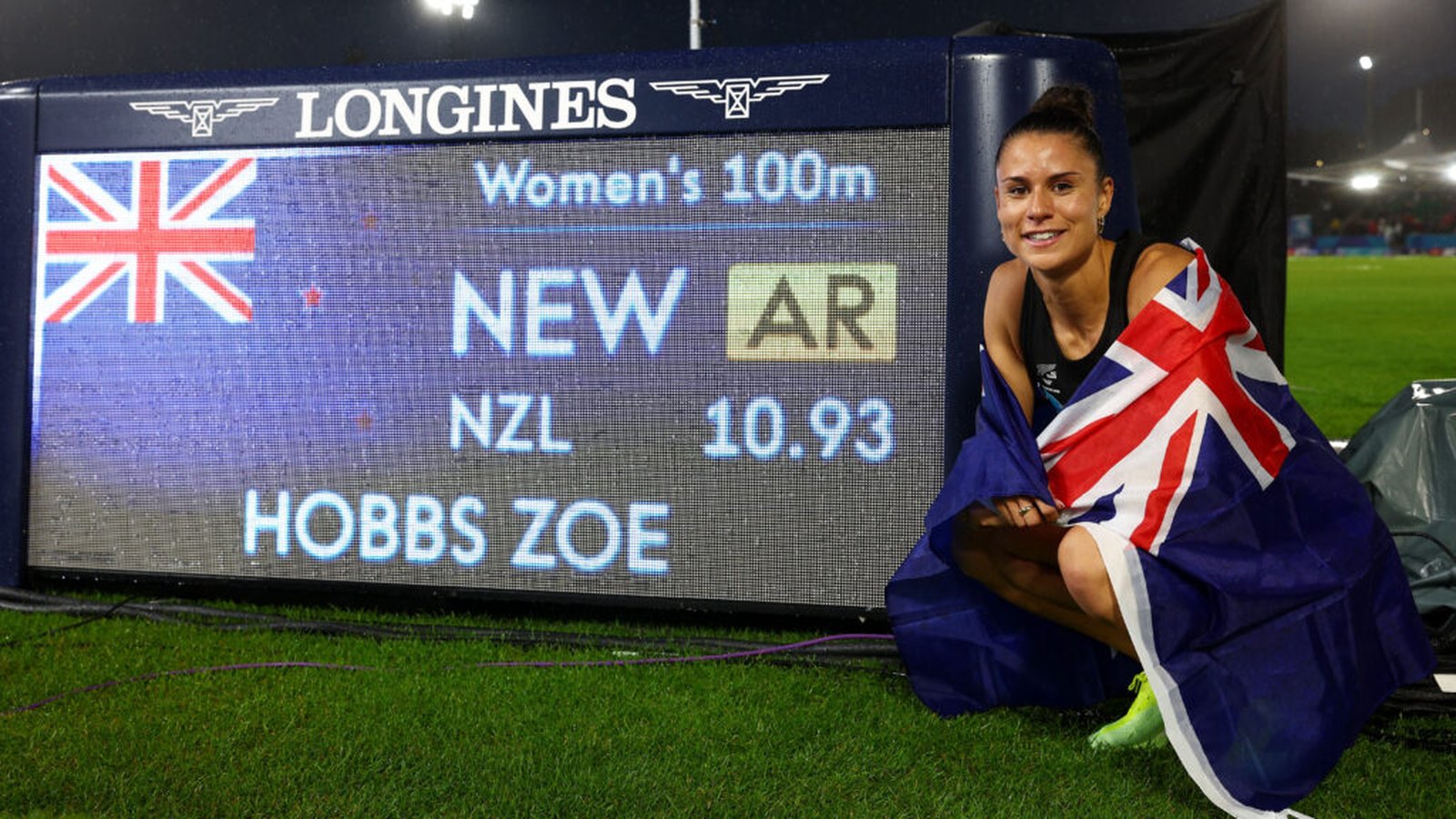
Zoe Hobbs has delivered one of New Zealand's clearest Commonwealth Games sprint breakthroughs, winning the women's 100 metres in Glasgow in 10.93 seconds. Athletics New Zealand described the run as historic, while the New Zealand Olympic Team recorded Hobbs as the gold medallist in the final at Scotstoun Stadium. The time lowered her national mark and set a fresh Oceania record, giving New Zealand a result that sits well beyond a normal medal-table update.
The final was run in difficult conditions, with international coverage noting heavy rain across the athletics programme. That did not stop Hobbs from producing the sharp start and composed finish that have made her New Zealand's leading sprinter. England's Amy Hunt took silver in 10.98 seconds, while Australia's Torrie Lewis won bronze in 10.99. The gap at the line was small, but the significance for New Zealand was large: Hobbs became the first New Zealand woman to win a Commonwealth Games 100m title.
The result also changes the way her career is framed. Hobbs has already been the first woman from Oceania to break 11 seconds, and she arrived in Glasgow with years of national records and international finals behind her. A Games gold turns that consistency into a championship moment. It gives younger sprinters in New Zealand a simple reference point: the country's fastest woman has now converted world-class speed into a major title under pressure.
For the wider team, the medal arrived during a busy Glasgow programme and gave New Zealand an early athletics highlight. Lauren Bruce's hammer silver, also noted by the New Zealand Olympic Team, added depth to the same session. Those results matter because Commonwealth Games athletics is often judged by visible breakthroughs rather than only by total medal count. Hobbs' win will be replayed because it is easy to understand: one lane, one final, one New Zealander crossing first in a race that historically has been dominated by larger sprint nations.
Hobbs' 10.93 also raises expectations carefully. Sprint results can move quickly with wind, weather, track conditions and championship pressure, but a legal sub-10.95 championship run is elite by any measure. It puts her into a small group of athletes capable of reaching finals and challenging for medals when execution is clean. The next challenge is not proving that New Zealand can produce a world-class female sprinter. Hobbs has already done that. The next challenge is repeating the standard often enough that it becomes normal for her and believable for those coming behind her.
The win is a national sport story because it is both measurable and emotional. There is no complicated table to decode and no subjective judging panel to debate. Hobbs ran 100 metres faster than anyone else in the final. For a New Zealand public used to celebrating rugby, rowing and endurance success, this is a different kind of sporting statement: pure sprint speed, delivered in a championship final, with a gold medal attached.
It also gives the Glasgow campaign a moment that can travel beyond athletics fans. A 100m final is short enough for casual viewers to watch, replay and understand, and the record time gives the achievement a clean statistical anchor. That combination makes Hobbs' gold one of the most accessible New Zealand sport stories of the Games so far.