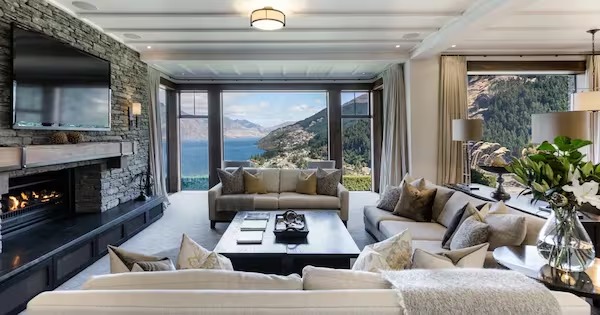
A luxury Queenstown estate expected to sell for about $35 million is about to test the top end of New Zealand's property market. 1News reported that the 4065 square metre property is being listed for the first time on the New Zealand and Australian markets, with New Zealand Sotheby's International Realty managing director and listing co-agent Mark Harris describing it as a legacy estate.
The property sits in a completely different world from ordinary buyer concerns, but it is still useful market evidence. At one end of the country, many households are watching interest rates, insurance, deposits and house prices with caution. At the trophy end, agents are testing whether wealthy buyers still see Queenstown as one of the country's strongest stores of lifestyle value. Both parts of the market can be true at the same time.
The details help explain the price expectation. 1News said the Mason & Wales-designed home includes five bedrooms, six bathrooms, multiple living areas, a bar, cinema, library, sunroom, wine cellar, sculptural spiral staircase and secluded guest wing. The residence itself covers 1115 square metres. Harris called it architecturally significant and said it occupied one of the country's most beautiful locations.
The comparison point is also striking. The highest reported New Zealand property price cited by 1News was a $45.5 million, 19-hectare Queenstown estate sold in 2023. A $35 million result would not beat that, but it would still place the home among the country's most expensive residential sales if achieved. In a softer wider market, that makes the campaign worth watching.
Trophy homes are not priced like ordinary homes. Buyers at this level are not choosing between a fixed-rate mortgage and a smaller section. They are weighing privacy, architectural status, scarcity, views, international lifestyle, family use, security, tax position, currency, and whether the property can become a long-term base. That is why agents use language such as legacy estate and global interest. The product is partly a home and partly an asset class.
Queenstown has advantages in that market. It has scenery, airport access, skiing, hospitality, wine regions and a global visitor brand. It also has constraints: infrastructure pressure, workforce housing challenges, land limits and debates about who benefits when very high-value property demand keeps lifting attention and prices. A $35 million listing can support the prestige story while also underlining the gap between wealthy buyers and local affordability.
The sale campaign will be read differently by different audiences. Luxury agents will see confidence if serious buyers engage. Local businesses may see potential for high-value residents and visitors. Residents priced out of the district may see another reminder that Queenstown's housing problem is not only about supply, but about competing uses of land and capital.
The important test is not simply whether the estate sells. It is whether the expected price is met in a market where ordinary listings have often had to become more realistic. If Queenstown's trophy segment can still command large numbers, it will show the luxury market remains partly insulated from the pressures facing the wider housing market. If it cannot, even the top end may be hearing the same message as everyone else: price still matters.