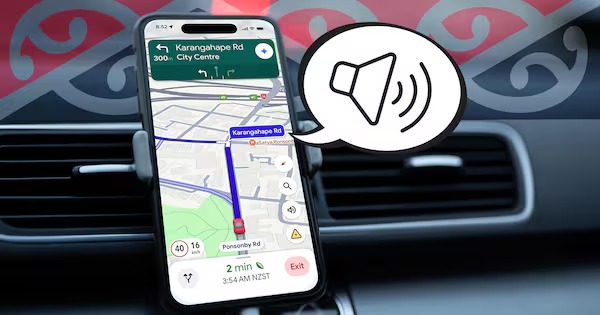
Google is turning a daily navigation tool into a test of how large technology companies work with New Zealand language, culture and public institutions. The company is rolling out a new voice for the New Zealand version of Google Maps that speaks English with a local accent and is designed to pronounce te reo Maori place names correctly for the first time.
The change was announced by Google New Zealand country director Caroline Rainsford, who told 1News the feature should be available from next week. For most users who already have the New Zealand English voice selected, the update is expected to arrive automatically. That makes the business significance larger than a niche app setting. It puts a more local voice into the cars, phones and daily routines of people who may not actively seek out te reo pronunciation tools.
The project was developed with Te Taura Whiri i te Reo Maori, the Maori Language Commission. Chief executive Ngahiwi Apanui-Barr said hearing names pronounced correctly helps people say them correctly, and makes the language visible in the country rather than confined to formal lessons or ceremonial settings. His example was the Wellington suburb Ngaio, which had been confusingly rendered by older navigation voices.
Rainsford said the voice is a text-to-speech model made possible by advances in AI. She said Google spent about six months training the model using recordings of a New Zealand voice actor chosen for both a Kiwi English accent and strong te reo pronunciation. Te Taura Whiri was involved in quality checks and helped bring the right people into the process.
The intellectual-property arrangements are important because language data is not ordinary software input. Apanui-Barr said Te Taura Whiri would be the guardian of the Maori lexicon model until a group of Maori specialists in technology and language can be established to oversee it. He also stressed that Te Taura Whiri does not own te reo Maori, because the language belongs to Maori people. Google, for its part, licenses the data for the text-to-speech model rather than claiming ownership of the language.
That distinction should matter to other technology companies operating here. AI systems increasingly depend on local linguistic, cultural and geographic data. If that data is gathered poorly or controlled without community oversight, the product may look modern while weakening the communities whose knowledge makes it valuable. If the partnership is done carefully, a commercial tool can help normalise correct pronunciation at scale.
For Google, the feature is also a product-localisation move. Navigation apps compete on trust, convenience and accuracy. A map voice that mishandles local names reminds users that a global platform is still seeing the country from outside. A voice that gets those names right makes the product feel more useful and less generic.
The wider question is whether this becomes a one-off upgrade or a model for future AI work in Aotearoa. Apanui-Barr said Maori need to engage with AI development, particularly where language is involved, because important decisions should remain with people. That is the practical lesson from the launch. Good localisation is not only about better pronunciation. It is about who shapes the system before millions of people hear it.