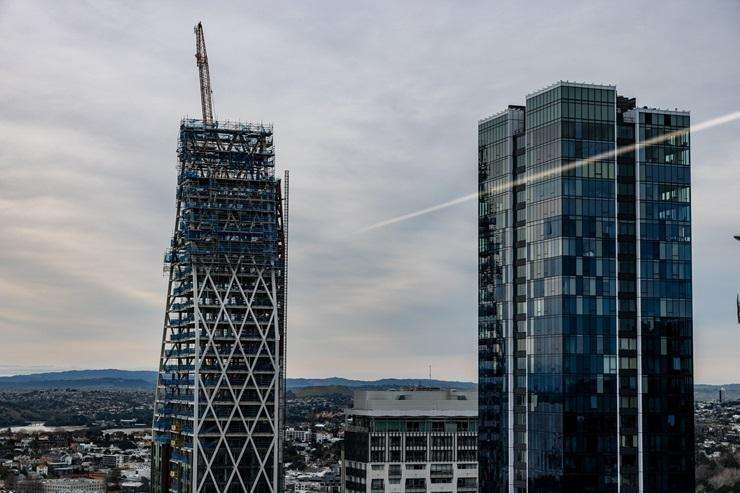
Auckland's unfinished Seascape tower has become a test of how much risk major property buyers are willing to take, with 44 potential buyers signing non-disclosure agreements for the receiver-led sale of the $300 million project and related properties. The 56-storey CBD tower stopped work in 2024 and is now being marketed on an as-is, where-is basis by Bayleys.
The property significance is larger than one skyline landmark. Seascape sits at the point where ambition, construction cost, finance, presales, regulation and market confidence meet. A half-finished tower can be an eyesore, a balance-sheet problem and an opportunity at the same time. Buyers are not only asking what the tower could be worth when complete. They are asking what it will cost to understand, remediate, insure, consent, finish, hold and sell.
Bayleys head of commercial property Ryan Johnson said 44 interested parties had entered the data rooms. That is a strong signal of curiosity, but not yet proof of a clean sale. Data-room access is the beginning of serious analysis, not the end of it. The next stages will test whether global and local buyers can price the unknowns with enough confidence to proceed.
The campaign matters for Auckland because large stalled projects affect more than their owners. They shape confidence in the CBD, influence nearby businesses, and raise questions for apartment buyers who watch construction cycles carefully. A completed landmark can add residents, rates, street life and confidence. A stalled landmark can do the opposite, reminding people that high-rise development depends on finance and execution as much as design.
The sale also arrives against a mixed housing-market backdrop. Cotality's June chart pack described first-home buyers as active in a subdued market, while prices remained broadly flat and buyers retained plenty of choice. That is the residential street-level picture. Seascape is a different kind of asset, but it still sits inside the same wider environment of cautious capital, high construction costs and buyers who expect discounts for risk.
For any successful buyer, the due-diligence list will be long. Structural status, building services, warranties, subcontractor history, body corporate planning, apartment purchaser obligations, consents, financing and programme risk all need to be understood. Demolition has also been discussed publicly as a costly possibility. Completing a tower can be expensive, but abandoning work already done can be expensive too.
There is a public-policy angle as well. Cities need confidence that major projects can be completed without leaving long-term scars in prominent locations. That does not mean councils should underwrite every private development. It does mean planning, consenting, lending and presale systems should make distress visible early enough for realistic interventions or market solutions before a project becomes a symbol of failure.
The Seascape sale will not define the whole Auckland property market, but it will say something about distressed development appetite. Forty-four potential buyers in a data room show that the ghost tower still has attention. The harder test is whether one buyer can turn attention into a credible plan, a viable price and a finished building.