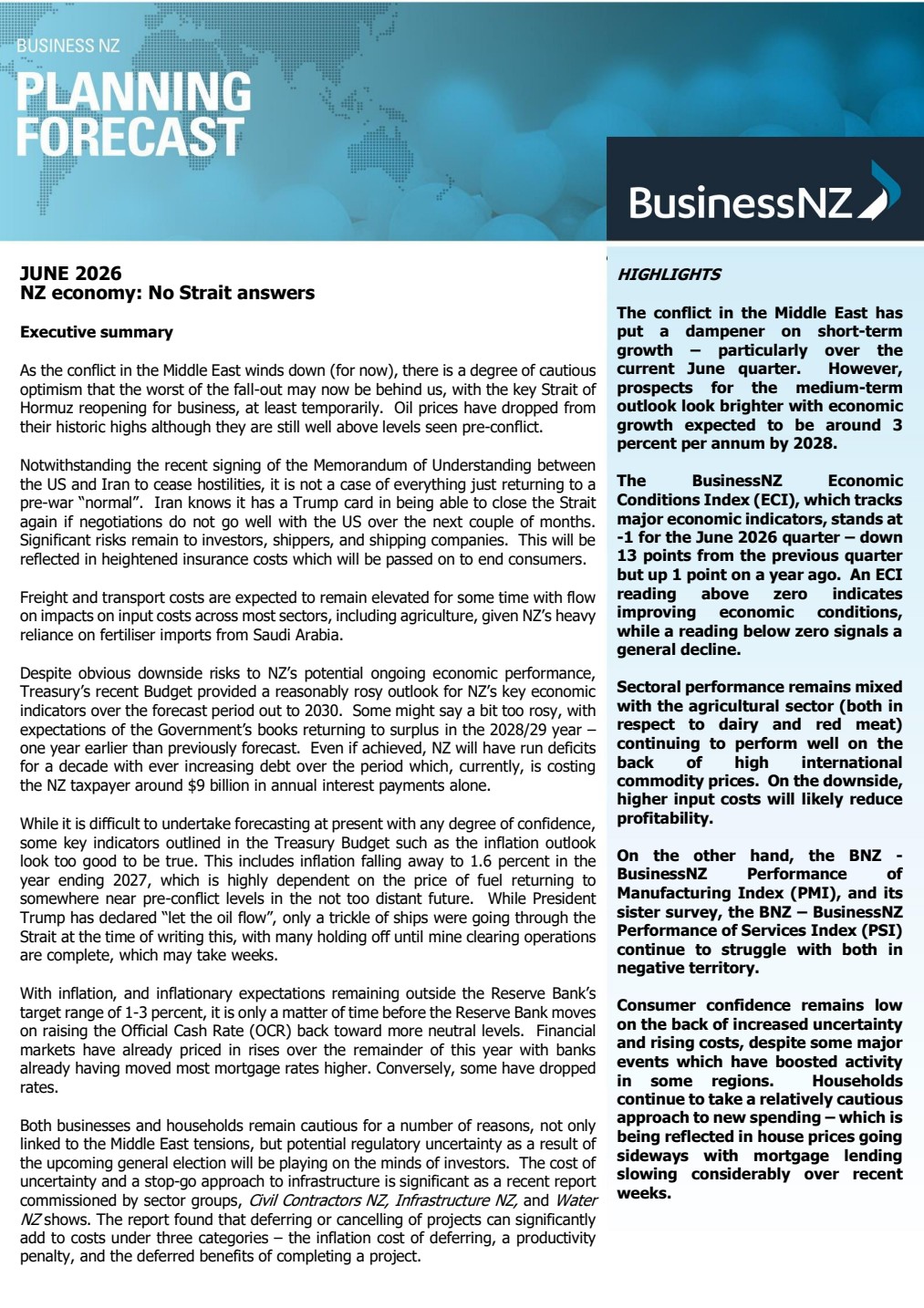
BusinessNZ's June Planning Forecast gives New Zealand firms a recovery story that is useful but still uneven. The report says exports are providing one of the clearer supports for the economy, with total exports valued at $8.9 billion in May 2026, up $1.4 billion, or 18 percent, from the same month last year. Meat, dairy, aluminium and fruit led the increase. That is a strong signal for exporters and regional producers, but it is not a simple all-clear for the wider business sector.
The reason is that a recovery led by exports can feel distant from the daily conditions facing domestic firms. A manufacturer selling offshore may see stronger orders while a suburban cafe, personal services operator or retailer is still watching customers delay discretionary spending. BusinessNZ's Performance of Services Index for May was 47.5, below the 50-point line that separates expansion from contraction. BusinessNZ chief executive Katherine Rich said the weakest service industries included cafes and restaurants and recreational and personal services, the parts of the economy most exposed to cautious household spending.
That split should shape how business owners read the latest forecast. It is possible for national indicators to improve while the cash register in many businesses remains quiet. Export volumes, prices and overseas demand help the country earn income, but domestic service firms need consumers who feel secure enough to spend. Mortgage pressure, insurance, rates, food costs and job insecurity still sit between a positive macro report and actual demand on the ground.
The trade numbers also contain a warning. Imports were valued at $8.1 billion in May, up $1.7 billion, or 26 percent, compared with a year earlier, with petroleum and petroleum products accounting for almost half the increase. For firms that depend on transport, freight, packaging, refrigeration or imported inputs, a stronger export headline does not remove cost pressure. Rising import values can squeeze margins even as some revenue lines improve.
BusinessNZ's value here is in the balance. The report points to areas where the economy is lifting, but it also makes clear that structural risks cannot be ignored. Firms are planning under global uncertainty, fuel-price risk, soft household demand and persistent labour-market caution. A realistic owner will therefore treat the forecast as permission to prepare, not permission to overextend.
For exporters, the near-term question is whether current demand can be converted into capacity, investment and hiring without being caught by another cost shock. For domestic service firms, the question is whether they can survive the slow recovery long enough for confidence to return. Some will need to refine menus, hours, staffing, pricing and online sales. Others will need bank flexibility and landlord realism.
The public-policy implication is straightforward. A recovery that depends on a few strong export categories is not enough on its own. New Zealand also needs better infrastructure, predictable regulation, skills, energy resilience and productivity gains that help firms in the domestic economy. Otherwise the country risks celebrating export strength while large parts of the service sector remain stuck in contraction.
The best reading of the June forecast is therefore cautious optimism. New Zealand business has live sources of strength, especially in exports. But the recovery is still patchy, and the businesses closest to household spending need evidence from customers before they can call it real.