
Two Auckland cleaning operators were brought into Candoo with a simple commercial bargain: to bring approximately $250,000 of existing cleaning work into the franchise network, or pay the standard $50,000 regional franchise fee.
Candoo says they did neither.
Instead, Shan Fernando and Jay Mohottige allegedly continued operating a rival cleaning business, diverted leads that should have supported Candoo franchisees, and then helped organise those same franchisees against the company when the promised work failed to appear.
The result, Candoo says, was a calculated reversal of responsibility. The people entrusted with providing work to Auckland franchisees allegedly kept opportunities for themselves, while Candoo was blamed for leaving those franchisees empty-handed.
A deal built around $250,000 of work
In June 2025, Fernando and Mohottige negotiated to become Candoo's Auckland regional master franchise operators through their business, Luxeora Eleven Limited.
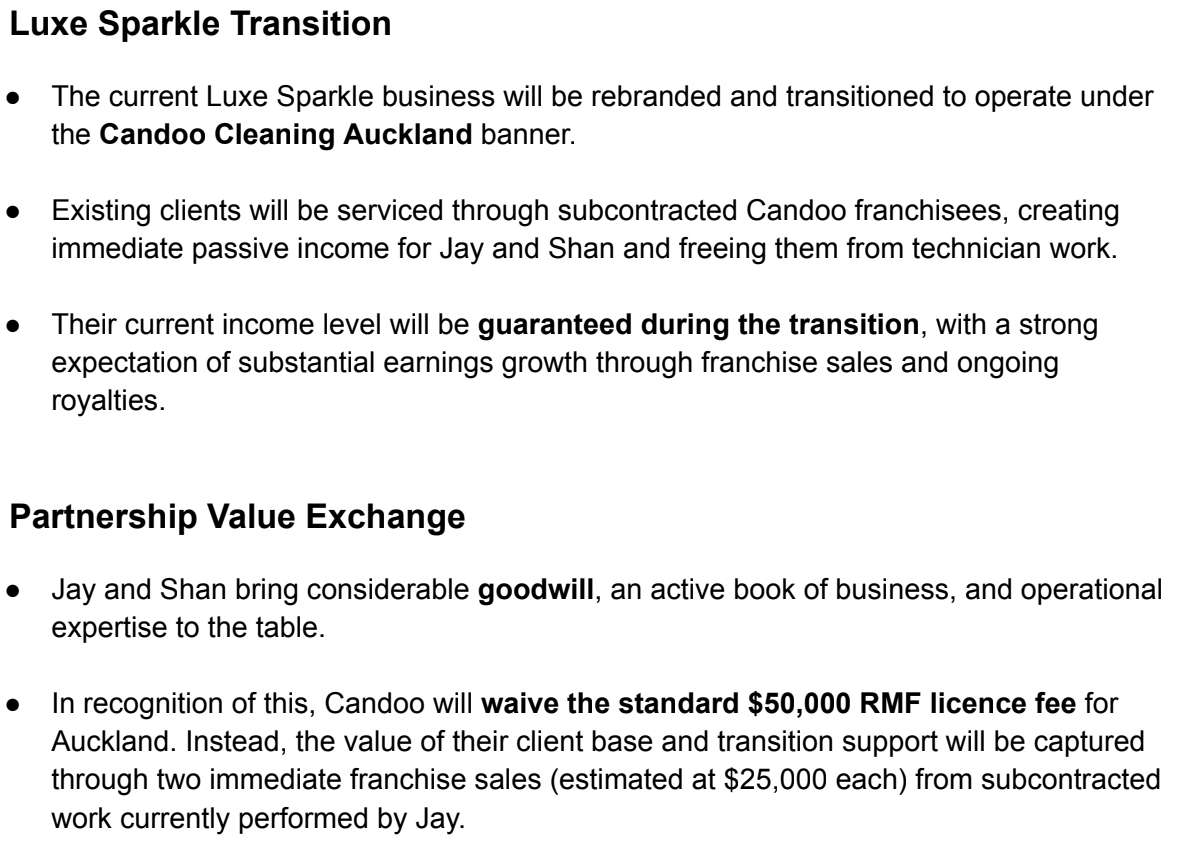
A proposal circulated during those negotiations recorded that their existing cleaning operation, Luxe Sparkle, would transition into Candoo Cleaning Auckland. Approximately $250,000 in annual cleaning revenue would then be introduced into the network and serviced by existing Candoo franchisees.
In exchange for that work and goodwill, Candoo proposed waiving its standard $50,000 regional master franchise fee.
The arrangement was intended to allow Fernando and Mohottige to step away from day-to-day cleaning and move into regional leadership. Their responsibility would be to find work, develop the Auckland market and help the franchisees operating beneath them build sustainable businesses.
The work never arrived.
Nor was the $50,000 paid.
Eventually, the matter proceeded to the Disputes Tribunal.
During tribunal proceedings, Luxeora relied on the proposal as evidence that the $50,000 fee had been waived. Candoo's position is that the waiver was never unconditional: it formed part of an agreed value exchange in which the operators would bring their existing portfolio into the network.
Franchisees left waiting
Candoo says Auckland franchisees were expecting the regional operators to supply work that could support their income guarantees and help establish their businesses.
Instead, they were left asking where the jobs had gone.
Candoo paid Luxeora Eleven Limited $19,778.52 in August 2025 while still waiting for the promised transition to take place. It says it continued trying to make the relationship work and later entered negotiations aimed at reaching an amicable exit.
No final release eventuated.
At a subsequent tribunal hearing, a Luxeora representative acknowledged that no binding termination agreement had been completed. The adjudicator also noted that Luxeora had been given months to produce evidence supporting its position that it was not required to transition or rebrand Luxe Sparkle, but had failed to supply that evidence before the resumed hearing.
By the end of the year, Candoo had issued a breach notice and a formal demand for the unpaid $50,000 fee. The tribunal bundle records Candoo's position that Luxeora stopped operating the regional business, did not deliver the promised portfolio and failed to pay the establishment fee required under the signed agreement.
But the missing work was only part of the problem.
A rival business operating alongside the franchise
Candoo alleges that while Fernando and Mohottige had access to its franchisees, systems, customer opportunities and sales pipeline, they continued running cleaning work through their own operation.
The company says leads supplied through Candoo were placed under the operators' outside business rather than being allocated to the franchisees they had been appointed to support.
That allegation cuts to the heart of the regional franchise relationship.
Fernando and Mohottige were not ordinary subcontractors free to pursue whichever opportunities they chose. They had accepted responsibility for developing the Auckland region and supporting franchisees who had invested on the understanding that the regional operators would help provide them with work.
The signed agreement contained restrictions against involvement in a competing or substantially similar business without Candoo's consent. Candoo later issued a cease-and-desist notice alleging that the pair were promoting another cleaning business, attending networking meetings in association with it and approaching people connected with the Candoo network.
Candoo described the alleged conduct as a betrayal of the franchisees.
"It is appalling that not only did they not bring the work into the business for their franchisees, but they then ran another cleaning business in competition to their own franchisees," the company said.
"The audacity to then claim an income warranty whilst they owed the company $50,000, after running an independent cleaning business in direct competition to the very franchisees they were meant to be helping, is disgusting."
Franchisees say Candoo was blamed
The people most immediately affected were the Auckland franchisees who had been waiting for contracts.
Jaimin Patel, one of four franchisees who came forward about the matter, said Candoo was unfairly blamed for problems created at the regional level.
"Candoo has received a bad rap in the media because of people like Shan and Jay; however, they have done nothing but good things for us," Patel said.
"After Shan and Jay did not provide any work, Candoo put a new regional manager and business developer in place who quickly secured us the work for our income guarantee. We are happy now and our income is well above what we expected."
His account exposes the central problem, Candoo claims.
When work did not arrive, franchisees naturally looked to the Candoo name. What they may not initially have understood was that Fernando and Mohottige had been appointed to develop the Auckland territory and were expected to bring a significant portfolio into the network.
Candoo alleges that, rather than accepting responsibility for that failure, the former operators helped direct franchisee anger back toward the franchisor.
A group chat aimed at Candoo
Screenshots reviewed by this publication show that, after leaving the business, Fernando and Mohottige created a group chat and began adding Candoo franchisees.
Candoo says the chat was used to criticise the company and coordinate opposition against it.
Franchisee Nalaka Anuranga said he was added without his permission.
"Shan just added me to a group chat without asking me," Anuranga said. "I didn't participate. They were discussing ways to hurt Candoo."
Candoo argues that it is not simply that the regional operators failed to deliver. It is that they allegedly failed to provide the work, continued operating independently and then helped persuade affected franchisees that Candoo itself was responsible for their losses.
Unsavoury connections
Candoo says Fernando and Mohottige were aligned with former Christchurch regional operator Faamasinoga Eneliko, known as Lex.
Eneliko had also established a separate cleaning business, Fantastic 4 Commercial and Domestic Cleaning, whilst still a regional master franchisee with Candoo.
A previous investigation reported allegations that Eneliko used relationships formed inside Candoo to draw franchisees and cleaning contracts toward his own operation. It also reported that, after Candoo sought repayment of money it had advanced to him, Eneliko approached staff and franchisees and portrayed the company as having wronged him. Read the earlier investigation.
Candoo says the Auckland and Christchurch operators facilitated group communications involving franchisees discrediting Candoo.
The company further alleges that members of the group approached clients and used negative media coverage about Candoo as a reason those clients should leave the network and move their work elsewhere.
Candoo says clients have directly reported those approaches to it, forming part of a continuing campaign that caused further customer losses, reputational damage and legal expense.
The company left holding the bill
Fernando and Mohottige dispute Candoo's position. They say the June proposal waived the $50,000 fee and that Candoo owes them further income-warranty payments.
Candoo's answer is that the fee was waived only because $250,000 of cleaning work was meant to be transferred into the network.
That work never came.
Instead, Candoo says it was left paying franchisees for expected work, replacing the regional leadership, investing further money into sales and business development and defending itself against legal claims and public criticism.
Meanwhile, the former operators continued building businesses outside the network.
Candoo says Fernando and Mohottige were given access to a brand, a pipeline, customer opportunities and a network of franchisees. They were trusted to bring work into that network and help those franchisees succeed.
Instead, the company alleges they withheld the very work that justified their appointment, competed against the franchisees they were supposed to support and then helped blame Candoo for the damage left behind.
The tribunal will determine the parties' competing financial claims.