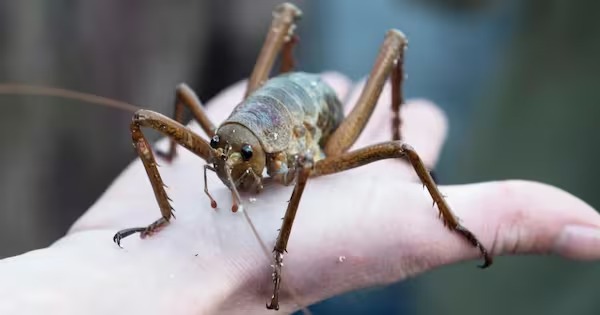
New Zealand's heaviest insect has become a conservation success story, with new reporting on a breeding and release programme showing how patient, specialist work can change the prospects of a threatened species.
1News, carrying RNZ reporting, said weta were once widespread across Northland and Auckland but had been reduced by the 1990s to one remnant population on Little Barrier Island. Small numbers were collected to begin intensive breeding, and tens of thousands have now been bred through work involving Butterfly Creek and Auckland Zoo.
The recovery has now been documented in the New Zealand Journal of Zoology. The Science Media Centre summarised the research as a large-scale programme involving DOC, Unitec, Auckland Zoo, Butterfly Creek and Otorohanga Kiwi House. The article notes Auckland Zoo's programme alone bred and released 8,874 weta from 2014 to 2025.
The headline classification change is striking: from Nationally Endangered in 2004 to Nationally Recovering. But the deeper story is the structure behind that shift. Conservation often looks simple once the result is visible. In reality, it depends on permits, iwi relationships, island pest control, breeding knowledge, specialist facilities, monitoring, transport, staff skill and long funding horizons.
DOC's species information explains why the programme mattered. When an entire species is effectively confined to one island, it is exposed to a single catastrophic event: fire, disease, extreme weather or predator incursion. Breeding and release work spreads that risk by creating additional populations on predator-free islands.
The programme also shows the value of invertebrate conservation. Birds and marine mammals usually receive more public attention, but New Zealand's identity as a biodiversity hotspot includes animals many people rarely see. Large weta are part of the country's ecological history, and protecting them requires a public imagination wide enough to include insects as taonga, not just backdrop.
There is a useful local angle too. Auckland Zoo and Butterfly Creek are public-facing institutions, not hidden laboratories. Their work lets families encounter conservation as something active and practical. A child who sees a weta breeding programme can understand that saving a species is not only a slogan; it is husbandry, release planning and years of follow-through.
The success should not be read as a reason to relax. Nationally Recovering is not the same as secure forever. Island habitats still need protection, introduced predators remain a constant risk, and climate pressures can change the conditions that recovery plans were built around.
Still, the weta story is a rare conservation headline with measurable progress. It says that careful captive breeding and predator-free release sites can work when institutions stay with the problem long enough. In a country used to biodiversity decline, that is worth treating as both good news and a practical model.
The next step is keeping the public connected to the work after the celebratory headline passes. Recovery programmes need patient support when there is no dramatic release photo, no viral animal moment and no easy political payoff. Weta recovery shows that quiet conservation can still deliver visible results if enough people keep doing the slow work.