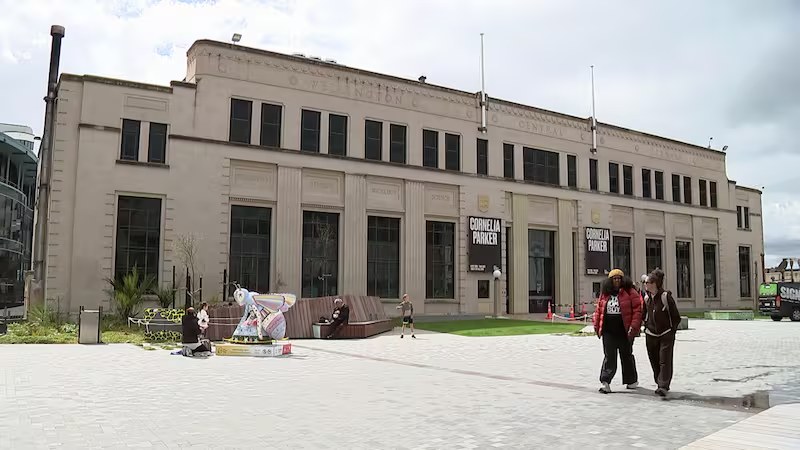
Wellington's City Gallery Te Whare Toi has reopened after more than two years away from the public, turning a $12.3 million earthquake-strengthening project into an immediate test of whether a safer building can also reset the capital's cultural energy.
The reopening exhibition features more than 50 works by British artist Cornelia Parker across two floors. One centrepiece, Cold Dark Matter, suspends the remains of an exploded garden shed around a ball of light, giving the reopening a blunt metaphor for destruction, reconstruction and what survives a blast.
Gallery director Charlotte Davy told 1News the show was a fitting way to reveal the renovated building because Parker's work would not have been possible in the old space. That matters for Wellington because strengthening work is often discussed only as a compliance cost. The public value becomes clearer when the upgraded building can host work that was previously out of reach.
The council spent $12.3 million after the gallery was designated earthquake-prone in 2024. The project followed the reopening of the Central Library next door in March, meaning two important civic buildings have now returned to the city centre after long disruption. For retailers, hospitality operators, students and office workers, cultural foot traffic is part of the central-city economy, not a decorative extra.
Parker's exhibition also gives the gallery a high-profile reason for people to revisit a familiar institution. Alongside Cold Dark Matter, 1News reported highlights including steamrolled brass instruments, a deconstructed barn from Alfred Hitchcock's Psycho and Blue Shift, which had not been shown publicly for 20 years.
The question for Wellington is whether the reopening can become more than a one-weekend burst of attention. The city's arts venues have had to compete with cost-of-living pressure, earthquake work, office vacancy and changing commuter habits. A strong exhibition can pull people in, but the deeper challenge is making the gallery feel like a living part of the city again.
The public now has a simple way to judge the spending: does the building feel open, useful and worth returning to? Parker's work invites visitors to bring their own associations rather than look for a single approved interpretation. That is a good starting point for a reopened civic space. It lets people test the building emotionally, not just technically.
The exhibition runs until March next year. By then, Wellington will know whether the reopening has become a sustained cultural draw or just another completed capital project. For a city still rebuilding confidence in its centre, the answer matters.