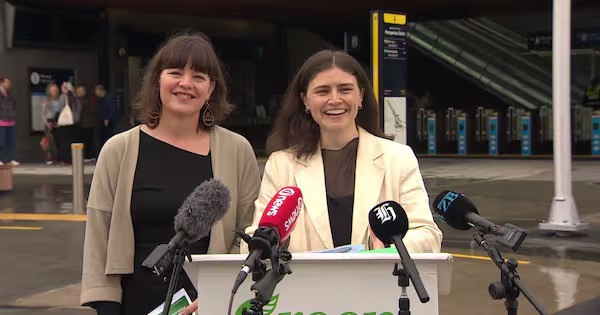
The Green Party has put public transport fares and inter-city rail back into the centre of the election argument, promising free buses and trains for children, teenagers, students, apprentices, Community Service Card holders and Total Mobility users, plus a $2 adult fare cap.
The party's Connecting Aotearoa plan also includes mass rapid transit in Auckland, Wellington and Christchurch, an overnight passenger train between Auckland and Wellington, and a return of passenger rail between Christchurch and Dunedin. 1News reported the fare changes had been costed by the Parliamentary Library at $262 million in 2027/28, rising to $381 million by 2030/31, with the Greens saying their tax policy would cover the cost.
The politics are obvious, but the practical test is sharper. Public transport promises are attractive because households feel petrol, parking and congestion every week. A lower fare is easy to understand. What is harder is whether cheaper travel also comes with services that are frequent, safe, reliable and close enough to where people actually live.
That distinction matters in Auckland, Wellington and Christchurch, where the party is linking fare relief with rapid transit. A $2 fare cap can help a worker or student immediately, but if the bus is late, infrequent or stuck in traffic, price alone will not change behaviour. The credibility of the policy therefore depends on both operating subsidies and the physical network behind them.
The rail revival plank will draw a different debate. Supporters will argue that long-distance passenger rail gives New Zealanders more travel choices and helps reduce dependence on domestic flying and long car trips. Critics will ask whether the routes can attract enough passengers, how much track and rolling-stock investment would be needed, and whether money should go first to urban bus and rail capacity.
The Greens are trying to make transport a cost-of-living issue as well as a climate issue. That is a useful shift because voters who are not moved by emissions language may still care about weekly fares, household budgets and congestion. But it also raises the burden of proof. If a party promises relief, voters will want to know when it arrives, who receives it, and whether councils and operators can deliver it without service cuts elsewhere.
The proposal also lands in a campaign where transport policy is being pulled in several directions: roads, rail, buses, climate targets, regional access, school travel, disabled mobility and city growth. Connecting Aotearoa gives the Greens a clear alternative to road-led politics. The election test is whether voters see that as practical infrastructure or an expensive aspiration.
The strongest immediate pressure will be on delivery partners. Councils, regional transport authorities, NZTA and operators would have to translate a national promise into fares, contracts, timetables, ticketing systems and public information. Those details are less exciting than a campaign launch, but they determine whether a family sees a clear saving or another confusing concession category.
For commuters, the most useful question is not ideological. It is whether the plan would make the trip to school, study, work, appointments or sport easier next year, not only by the end of a long construction programme. That is where the fare promises may have their strongest appeal, and where the implementation detail will matter most.